How Long Will This Hac Work Before My Dns Is Stale Again
Let's talk almost Sarah, a fashion designer from Berlin, and her bad chance with domain hijacking. She had recently launched her small internet retail showcase of vintage and pin-up clothing and dresses. She was very lucky to get a valuable domain name matching perfectly the name of her business organization. Inside a few years the acquirement first doubled, then tripled, and what had started equally a hobby was about to become her dream total-time chore. One day 1 of her best clients wrote to her that there seemed to be a problem with her website. Sarah typed the accost in the browser bar and she found out her domain proper noun redirected to some other similar website with vintage products. But despite looking very similar, this was non her showcase website! She rushed to call her Information technology expert but she was confused hearing: "It looks like your domain has been hijacked". She had never heard of this term earlier and, unfortunately, she had to experience it in the worst style. The unexpected worst case scenario had occurred: someone managed to obtain the ownership of her domain name, transferred information technology, and perhaps even sold it! At present it belongs to someone else, perhaps a competitor in another country. Overnight, forth with her web presence, she lost access to her online business organisation identity.
Domain hijacking has critical consequences for your business
Are you a domain possessor or do you run multiple domains for your clients? A successful domain hijacking is almost equivalent to depriving you of your business, profits, and earnings and it seriously impacts your future, leading to loss of customers and a worse online reputation. Among all the possible worst-case scenarios, domain hijacking can be a real nightmare come truthful. It happens out of the blue without warnings and information technology can remain unnoticed for hours or even weeks. We invite y'all to keep reading to discover how domains can become stolen and what yous tin can do to avoid this from happening.
What is hijacking?
In computer science, hijacking attacks are aimed at gaining unauthorized admission to information or services in the IT infrastructure.
Depending on where the attack is carried out, nosotros can place different types of hijacking techniques:
- DNS hijacking, also called DNS poisoning, corrupts the resolution of the DNS queries.
- IP hijacking, besides known as BGP or route hijacking, disrupts the normal routing of the network using the Border Gateway Protocol (BGP) to illegitimately accept over groups of IP addresses.
- URL hijacking, as well called typosquatting, relies on typos or mistakes made by the users in the website addresses. This fashion they are led to malicious websites.
- Domain hijacking, or domain theft, occurs when the hacker changes the registration of a domain proper noun.
Domain hijacking means losing the ownership of your domain proper noun
Usually, domain hijacking aims to connect an unsuspecting user to a malicious website past pretending to exist the 1 the user wanted to admission. Simply generally speaking, domain hijacking is understood equally a form of theft since the aggressor gains admission to a domain name without the consent of the original registrant.
How does domain name hijacking work?
When you type the address of a domain name in the browser, it will retrieve a DNS record. If this search is performed for the first time, or the record is no longer available in the enshroud, the browser has to communicate with a name server. This advice between browser/device and server can be catchy: it is exactly during the interaction and exchange of requests and responses that malicious actions have the potential to strike. Furthermore, communications that are non encrypted offer hackers several means to intercept and redirect users. In particular, domain hijacking occurs when a hacker attempts to access the account details associated with a domain to make unauthorized changes. This can include changing DNS name servers, setting a new domain condition, or transferring the domain proper name.
How can you lot protect yourself against domain hijacking?
There are several ways hackers can hijack your domain name. The vulnerabilities that come into play are not simply technical ones. As a domain owner, you play the main office in making sure to utilise the strongest defense force around your digital assets. Sometimes it's non your fault as a registrant. The hijackers could brand their fashion to your domain through your domain provider infrastructure. Let's see how you lot as the registrant, the domain provider and other technical aspects are involved in securing a domain name against hijacking.
Observe out more than virtually InterNetX's domain security
The registrant'southward vulnerable side
The registrant'due south neglect of proper security measures is i of the chief reasons domains get hijacked. Once you have registered a new domain proper noun you become access to its settings. Social engineering science including phishing techniques, malware, such every bit trojan, keylogger, or spyware can infect your systems and hands let hackers to gain your credentials to access your domain management panel. Furthermore, a variety of personal data, such as names, e-mail addresses, and other information related to domain registrations can be plant in the WHOIS data records. There hackers tin easily find information nigh you and your domain proper name. If they succeed in hacking your accounts, the domain buying and related notifications tin be changed. If possible, hibernate or use different login data for your domain owner's contour and the domain management organization.
Possible vulnerabilities affecting the domain provider
The other actor involved in domain management is the provider. Registrars are unremarkably aware of possible security issues but vulnerabilities can impact even major and global companies. If the hacker succeeds in accessing the backend services provided by the registrar, at that place is a high-risk potential for your domains. Hence, ever make sure to choose a trusted domain provider. InterNetX for example offers 4 layers of domain security, offering a sophisticated security concept on the administration, domain, proper name server, and server-side. Further safety measures include 2FA, DNSSEC, Anycast, IP restriction, WHOIS privacy, domain monitoring services, and admission command (ACL) management in the all-in-one domain management platform AutoDNS.
Technical reasons why domains go hijacked
At that place may as well be a third problem that could crusade the hijacking of your domain. Namely: Your domain registration has expired and you have not renewed it. If you neglect in post-obit this deadline, someone may register your domain and y'all will lose not only your domain but all services related to it, such as electronic mail and webspace. This activity is completely legal and yous won't have the chance to claim information technology dorsum. To prevent such a scenario, make sure to turn on the car-renewal choice and register the domains for longer periods.

Detect out more on domain renewal in our article.
What are hijacked domains used for?
Why are domain names hijacked? What tin can a hijacker do with a stolen domain? Hackers may desire to steal your domain for several reasons. Equally you tin can imagine they are always looking for economic gain. Ordinarily, the hijacked domains become inaccessible and your online identity under that domain, i.e. your website, is no longer to be establish. A ruinous consequence since your business relies on its website as a source of income. This is why the hacker may ask for a ransom to transfer the domain dorsum to you. In other cases, the hijacker could replace your website with another similar 1 and misuse it for phishing or other malicious action. A real threat for your users who may mistakenly enter their sensitive data, such as bank details, on this new bogus website. The hacker could besides impersonate your brand identity and impairment your reputation with fake news or negative statements. The hacker tin as well resell your domain name, one time it was successfully transferred.
Notable cases of domain hijacking
In the by few years, there were notable cases of successful domain thefts, targeting very well-known brands as well.
Probably the first case ever to capture media attention is related to the sex.com-domain during the dot-com bubble in the late 90s. For the first time, the U.Due south. court declared that internet domain names should be treated as real property, turning domain hijacking into a class of theft.
On Feb 25, 2015, Lenovo'south website redirected the users to an attacker-controlled page labeled as existence "the new and improved rebranded Lenovo website". The same hackers managed to hijack Google's master search page for Vietnam, redirecting users.
In contempo years domain hijacking was used likewise in some serious and sophisticated multi-year spying attacks similar the state-sponsored DNSpionage entrada targeting Lebanon and the United Arab Emirates (UAE), and the Bounding main Turtle, targeting national security organizations, mostly in the Heart East and North Africa. This is simply the tip of the iceberg considering the larger and about serious domain thefts target SMEs who mostly do not have plenty knowledge or skills to face and eventually solve the problem.
Three methods to recover a stolen domain
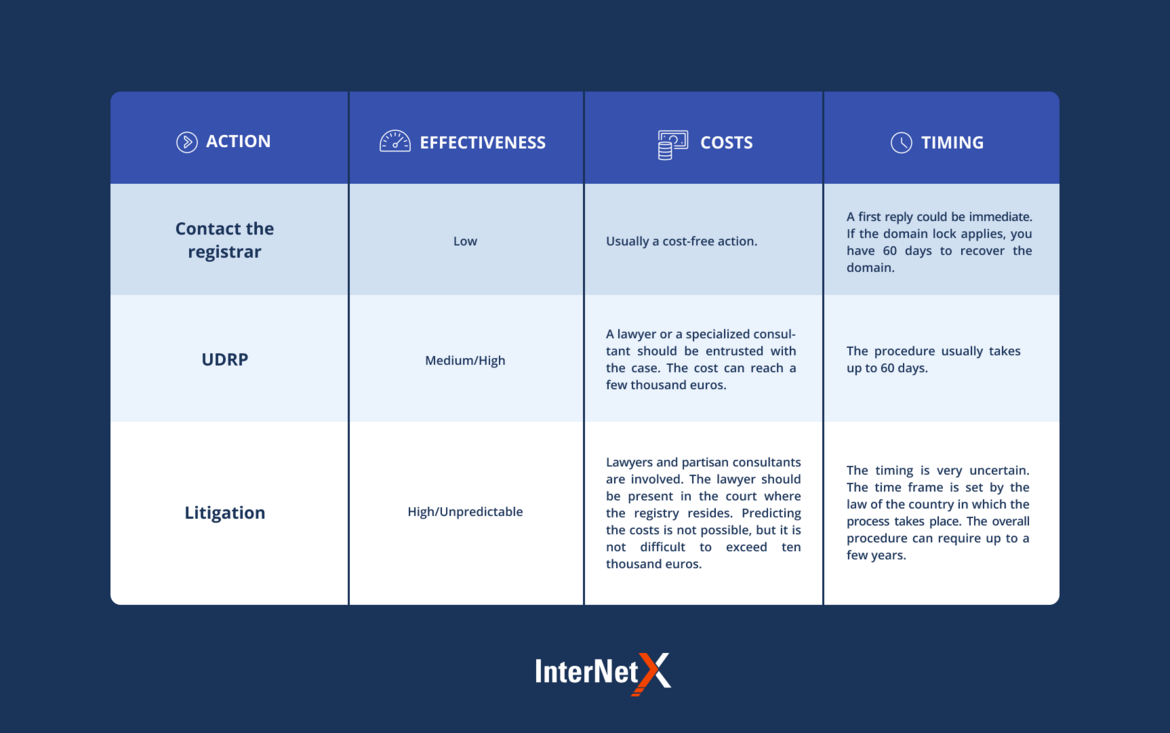
If the nightmare came true - all is not lost! Fortunately, there is still a gamble you can recover a hijacked domain. Here we present to you lot three possible methods, with different degrees of efficiency, cost, and timing.
1. Contact your registrar
Your domain provider is always the first betoken of contact when it comes to your domains. At the very moment you lot realize your domain has been stolen, inquire immediately for the transfer to be canceled. Ordinarily, the transfer process is subject to a 60-twenty-four hours transfer lock. The chance of recovery is higher if the domain has been transferred to an internal account at the same registrar, while if it has already been transferred to a different one, the registrar's willingness to collaborate comes into play. However, it is ever advisable to attempt this offset method right abroad, in the hope of resolving the issue chop-chop and containing any harm.
2. Address a UDRP complaint or equivalent procedures
The Uniform Domain-Proper name Dispute-Resolution Policy (UDRP) is an agreement that all ICANN-accredited registrars must abide by to settle disputes over the ownership of domain names for generic extensions such as .com, .internet, .info, etc. It was mainly designed to combat cybersquatting or infringements of registered trademarks, therefore it might non yield results if your domain name is not connected to a trademark. Amidst its clauses, still, the policy tin can be invoked as well to adjourn calumniating and bad faith hoarding. Therefore, it is not excluded that it may be useful in some other cases.
If yous own a registered trademark, the UDRP is the right procedure to follow. In this case, it has the advantage of allowing firsthand blocking of the domain, preventing its data from being changed or transferred to another registrar. Information technology should too block internal transfers between accounts of the same registrar. Once again, information technology all depends on how much the latter is cooperating.
Unfortunately, in the past years, the UDRP has opened the doors to some malicious actions called Reverse Domain Name Hijacking (RDNH). This practice occurs when the hacker tries to deprive someone of the domain name by alleging in bad faith the trademark rights connected to the domain.
Be aware that if your domain proper noun is under a ccTLD like .de, or .it, the national registries take their own regulations similar to UDRP, which allow y'all to object in case of improper transfers.
3. Pursue legal activeness
The UDRP has proved to be an constructive tool on several occasions, merely it may not exist the right i for you lot in the issue of a stolen domain. In this case, the communication of a lawyer or an expert in the domain industry is highly suggested. This action tin be filed both for the domain theft likewise equally for the probable hacking operation behind information technology. You tin appeal the court even if there are no registered trademark violations. The downside is that this procedure is oftentimes very lengthy and highly expensive. Furthermore, information technology should exist borne in listen that the process is carried out in the court where the relevant registry resides. For example, a legal activity continued to a .com domain will accept identify in Northern Virginia in the United States where the Verisign registry is based.
Simply if the court supports your claim, y'all can be sure to receive back your domain. It is going to be the registry's responsibility to take care of transferring the buying of the domain to you lot, bypassing the possibly uncooperative registrar.
How can you protect your domain?
The best defence force is a good offense - so here are some tips to prevent domain hijacking and secure your domain names.
1. Choose a reliable domain provider
Yous are not sure about the criteria that help y'all choose the all-time partner? First of all, make sure you're relying on an ICANN-accredited registrar. Toll is an important gene but practise not forget most security: cull a registrar that offers effective and constant technical support and excellent DNS management.
ii. Use the DNSSEC protocol
The DNSSEC (Domain Name System Security Extensions) protocol allows the browser to cosign the source, strengthening the actuality and integrity of your domain.
iii. Set strong passwords and change them periodically
Having a strong password is a vital practise in the digital environs. In one case you have created your domain management account, fix a strong and unique password, and proceed your associated electronic mail business relationship secure.
4. Use ii-cistron authentication
The 2FA adds an extra security layer. You can use it to log into your AutoDNS account for case and information technology will protect y'all from losing control over your domain name if someone tries to gain access to your username and password.
More than nearly 2FA in our article
5. Protect your business from phishing and scams
Phishing and scam emails are often sent under the guise of a trusted sender or domain name. E'er make certain to double-check who sent the electronic mail and under what URL you lot are typing username and password.
half dozen. Active the WHOIS Privacy
The WHOIS Privacy and WHOIS Privacy Plus offered past InterNetX hides WHOIS information from straight admission by third parties. The Plus option allows anonymous communications between domain possessor and inquirer.
Domain safety? InterNetX won't let you lot down!
Sarah, the vintage habiliment business owner from Berlin, was not able to recover her domain. She contacted her domain provider but they could non accept whatsoever actions as everything seemed to be correct on their side and her domain name was not notwithstanding connected to a registered trademark. She asked for a legal consultation but the cost was higher than she expected. Eventually, she chose to launch a make new domain name and start her digital showcase from scratch. This meant changing all the marketing materials and redirecting the traffic to this new domain.
Ensure the continuity of your online presence for you and your clients. Enhance sensation well-nigh cybersecurity threats and learn how to protect your digital space confronting domain hijacking.
Do you demand assistance with your domains?
Attain out to our domain support!
Source: https://www.internetx.com/en/news-detailview/domain-hijacking-how-to-get-back-hijacked-domains/
0 Response to "How Long Will This Hac Work Before My Dns Is Stale Again"
Enregistrer un commentaire